
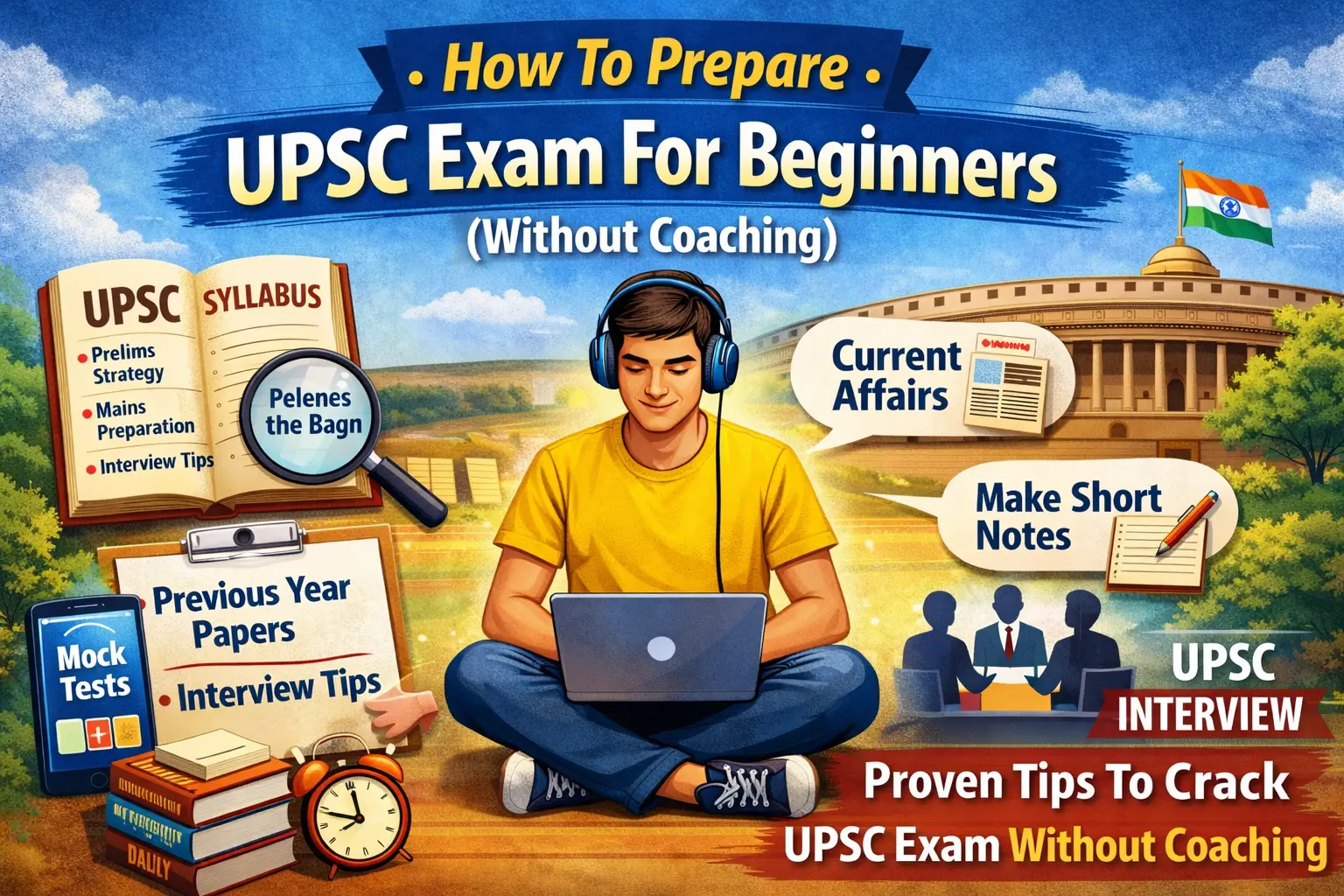
The Union Public Service Commission (UPSC) Civil Services Examination is considered one of the toughest exams in India. This is the question for all candidates that How To Prepare UPSC Exam For Beginners?. Every year, lakhs of aspirants apply for the exam, but only a small number successfully clear all stages and become civil servants such as IAS, IPS, and IFS officers.
Many beginners believe that coaching is necessary to crack the UPSC exam. However, several toppers have proven that it is possible to prepare and clear the exam without coaching. With the right strategy, proper study resources, and disciplined preparation, beginners can successfully prepare for UPSC from home.
How to write a research paper for beginners step by step
In this guide, we will explain how to prepare UPSC exam for beginners, understand the UPSC exam pattern and syllabus, and learn smart strategies to crack Prelims, Mains, and the Interview stage even without coaching.
Anuj Agnihotri (AIR-1) UPSC Topper 2025 –
Anuj Agnihotri ने UPSC Civil Services Examination (CSE) 2025 में All India Rank-1 (AIR-1) हासिल किया। इस परीक्षा का final result 6 March 2026 को घोषित किया गया।
यह भारत की सबसे कठिन प्रतियोगी परीक्षाओं में से एक है और 2025 के परिणाम में कुल 958 उम्मीदवारों को विभिन्न सेवाओं के लिए recommended किया गया।
Anuj Agnihotri (UPSC Topper 2025) – Profile
| Detail | Information |
|---|---|
| Name | Anuj Agnihotri |
| Rank | AIR-1 |
| Exam | UPSC Civil Services Examination 2025 |
| Result Declared | 6 March 2026 |
| Age | 26 |
| Hometown | Rawatbhata, Chittorgarh (Rajasthan) |
| Education | MBBS Graduate (AIIMS Jodhpur) |
| Attempt | 3rd Attempt |
| Previous Selection | DANICS service (2023) |
Anuj Agnihotri राजस्थान के Rawatbhata (Chittorgarh district) से हैं और उन्होंने AIIMS Jodhpur से MBBS किया है। मेडिकल पढ़ाई पूरी करने के बाद उन्होंने सिविल सेवा की तैयारी शुरू की और तीसरे प्रयास में AIR-1 हासिल किया।
Anuj Agnihotri Success Story
Anuj Agnihotri की सफलता कई UPSC aspirants के लिए प्रेरणादायक है।
- उन्होंने MBBS के बाद सिविल सेवा की तैयारी शुरू की
- लगभग 13 घंटे रोज पढ़ाई करते थे
- यह उनका तीसरा प्रयास था
- 2023 में वे DANICS (Delhi, Andaman and Nicobar Islands Civil Service) में चयनित हुए थे
उन्होंने self-study, answer writing practice और strong current affairs preparation पर विशेष ध्यान दिया।
Last Five UPSC Toppers List (AIR-1)
| Year | Topper Name (AIR-1) | Optional Subject | Total Marks |
|---|---|---|---|
| 2024 | Shakti Dubey | Sociology | 1043 |
| 2023 | Aditya Srivastava | Electrical Engineering | 1099 |
| 2022 | Ishita Kishore | Political Science & IR | 1094 |
| 2021 | Shruti Sharma | History | 1105 |
| 2020 | Shubham Kumar | Anthropology | 1054 |
UPSC Exam Pattern
Understanding the exam pattern is the first step in UPSC preparation. The Civil Services Examination is conducted in three stages, and candidates must clear each stage to move to the next level.
The three stages of the UPSC exam are Preliminary Examination, Main Examination, and the Personality Test (Interview). Each stage tests different skills such as knowledge, analytical ability, writing skills, and personality.
UPSC Preliminary Examination
The Preliminary Examination is the first stage of the UPSC exam. It acts as a screening test to select candidates for the mains examination.
The prelims exam consists of two objective-type papers.
| Paper | Subject | Marks |
|---|---|---|
| Paper 1 | General Studies | 200 |
| Paper 2 | CSAT | 200 |
Important points about the prelims exam:
- It contains multiple choice questions
- Only General Studies Paper 1 marks are counted for merit
- CSAT is qualifying in nature
- Candidates must qualify prelims to appear in mains
Prelims mainly tests the candidate’s basic knowledge and conceptual understanding of various subjects.
UPSC Main Examination
Candidates who qualify the preliminary examination appear for the mains examination. This stage is more detailed and tests the analytical and writing ability of aspirants.
The UPSC mains examination consists of nine descriptive papers.
| Paper | Subject |
|---|---|
| Paper A | Indian Language |
| Paper B | English |
| Essay | Essay Writing |
| GS 1 | History, Society |
| GS 2 | Polity, Governance |
| GS 3 | Economy, Science, Environment |
| GS 4 | Ethics |
| Optional 1 | Optional Subject |
| Optional 2 | Optional Subject |
The mains exam is extremely important because its marks are counted in the final merit list.
Candidates must focus on answer writing practice, clarity of concepts, and structured presentation.
UPSC Interview (Personality Test)
After clearing the mains exam, candidates are called for the final stage which is the UPSC Personality Test or Interview.
The interview carries 275 marks and plays an important role in determining the final ranking.
During the interview, the panel evaluates:
- Personality and confidence
- Communication skills
- Decision-making ability
- Awareness about national and global issues
- Leadership qualities
The interview is not a knowledge test but rather an evaluation of the candidate’s overall personality and attitude.
UPSC Exam Syllabus (Prelims and Mains)
The UPSC syllabus is vast and covers multiple subjects. Understanding the syllabus helps aspirants focus only on relevant topics instead of studying unnecessary materials.
Aspirants should always keep the official UPSC syllabus printed and plan their preparation accordingly.
UPSC Prelims Syllabus
The preliminary exam tests general awareness and conceptual clarity.
Important subjects include:
- Indian Polity and Governance
- History of India and National Movement
- Indian and World Geography
- Economic and Social Development
- Environmental Ecology
- General Science
- Current Affairs
Questions in the prelims exam often combine static subjects with current affairs, so both areas must be prepared simultaneously.
UPSC Mains Syllabus
The mains syllabus is more comprehensive and requires deeper understanding of subjects.
Important topics include:
- Indian Heritage and Culture
- Modern Indian History
- World History
- Indian Constitution and Governance
- Social Justice
- Economic Development
- Science and Technology
- Environment and Disaster Management
- Ethics and Integrity
Candidates must develop analytical thinking and strong writing skills to perform well in mains.
How To Prepare UPSC Exam For Beginners Tips-
UPSC preparation can seem overwhelming for beginners due to the vast syllabus. However, following the right preparation strategy can make the process more manageable.
Here are some effective preparation tips for beginners.
Understand the Syllabus and Exam Pattern
Before starting preparation, carefully analyze the UPSC syllabus and exam pattern.
This will help you understand:
- What topics to study
- What topics to avoid
- How questions are asked in the exam
A clear understanding of the syllabus prevents unnecessary study and saves valuable time.
Start With NCERT Books
NCERT books are considered the foundation of UPSC preparation.
These books help build basic concepts in subjects such as:
- History
- Geography
- Polity
- Economics
- Science
Beginners should start with NCERT books because they are simple, reliable, and concept-oriented.
Follow Limited Study Material
Many aspirants make the mistake of collecting too many books and study materials.
Instead of reading multiple sources, it is better to choose one standard book for each subject and revise it multiple times.
This approach improves retention and understanding.
Make Short Notes
Making short notes during preparation helps in quick revision before the exam.
Good notes should include:
- Important concepts
- Key facts and figures
- Government schemes
- Current affairs points
These notes become extremely helpful during the final revision phase.
UPSC Beginners Guide How to Crack UPSC Prelims ?
Cracking the prelims exam in the first attempt requires a smart and focused preparation strategy.
The key is to strengthen concepts and practice as many questions as possible.
Solve Previous Year Question Papers
It is the main key for How To Prepare UPSC Exam For Beginners- Previous year question papers help aspirants understand the nature and difficulty level of the exam.
By solving these papers, candidates can:
- Identify important topics
- Understand question patterns
- Improve problem-solving ability
Practicing previous papers is one of the most effective ways to prepare for prelims.
Take Regular Mock Tests
Mock tests simulate the real exam environment.
They help candidates improve:
- Time management
- Accuracy
- Confidence
Regular mock tests also help identify weak areas that require more focus.
Focus on Revision
Revision is the most important part of UPSC preparation.
Instead of continuously studying new materials, aspirants should revise the same subjects multiple times.
Frequent revision improves memory retention and exam performance.
How to Clear UPSC Mains in First Attempt without Coaching?
The mains exam is considered the most challenging stage because it requires detailed written answers.
A strong strategy and consistent answer writing practice are essential to clear the mains exam.
Practice Answer Writing
Answer writing practice is crucial for success in the mains exam.
Candidates should regularly practice writing answers for:
- Previous year questions
- Mock test questions
- Current affairs topics
This practice improves writing speed and helps develop a clear answer structure.
Improve Answer Presentation
Well-structured answers attract better marks.
Every answer should include:
- A short introduction
- A detailed body with key points
- A logical conclusion
Using bullet points and headings makes answers more readable.
Use Diagrams and Flowcharts
Wherever possible, aspirants should include diagrams, charts, and flowcharts in their answers.
Visual representation makes answers more attractive and easier for examiners to evaluate.
How to Prepare for UPSC CSE Interview?
The UPSC interview is not about testing academic knowledge but about evaluating the candidate’s personality and decision-making ability.
Candidates should prepare by:
- Reading their Detailed Application Form (DAF) carefully
- Staying updated with current affairs
- Practicing mock interviews
- Developing confidence and communication skills
Honesty, clarity of thought, and calm behavior are highly valued during the interview.
Problems Faced by UPSC for Beginners
Many aspirants face several challenges during their UPSC preparation journey.
Some of the most common problems include:
Lack of Proper Guidance
Beginners often struggle to find the right study materials and preparation strategy.
Information Overload
The UPSC syllabus is vast, which can confuse aspirants about what to study and what to skip.
Maintaining Consistency
Preparing for UPSC requires long-term dedication and discipline. Maintaining consistency throughout the preparation period can be difficult.
Previous Year UPSC Prelims Papers
Previous year question papers are one of the most valuable resources for UPSC preparation.
They help aspirants understand the trend of questions and the level of difficulty in the exam.
Candidates should regularly practice previous year papers and analyze their performance to improve preparation.
Previous Years UPSC Trend
In recent years, the UPSC exam has become more analytical and application-based.
Instead of asking direct factual questions, UPSC now focuses more on:
- Conceptual understanding
- Analytical ability
- Interdisciplinary knowledge
Therefore, aspirants must focus on concept clarity and practical understanding of topics.
Download UPSC Notes
UPSC preparation becomes easier when aspirants have access to well-organized study notes.
Good notes should include:
- Important concepts
- Current affairs summaries
- Government schemes
- Key statistics and reports
Candidates should also develop their own notes during preparation for better understanding and revision.
Final Thoughts
The UPSC Civil Services Examination is challenging but not impossible to crack. With proper planning, the right resources, and consistent effort, beginners can successfully prepare for UPSC without coaching.
The key to success lies in:
- Understanding the syllabus
- Building strong fundamentals
- Practicing answer writing
- Solving previous year papers
- Regular revision
With determination and disciplined preparation, every aspirant can move closer to achieving their dream of becoming a civil servant.
FAQs – UPSC Preparation for Beginners
1. How To Prepare UPSC Exam For Beginners without coaching?
Yes, it is absolutely possible to crack the UPSC exam without coaching. Many successful candidates have cleared the exam through self-study. With the right strategy, proper study material, regular revision, and consistent preparation, aspirants can prepare effectively from home.
2. How many hours should a beginner study for UPSC preparation?
A beginner should ideally study 6 to 8 hours daily in the beginning and gradually increase the study time as preparation progresses. Consistency and quality of study are more important than studying for long hours.
3. How long does it take to prepare for the UPSC exam?
On average, aspirants take 1 to 2 years to prepare for the UPSC Civil Services Examination. However, the preparation time may vary depending on the candidate’s background, understanding of subjects, and level of dedication.
4. What are the best books for UPSC beginners?
Some commonly recommended books for UPSC beginners include:
- NCERT Books (Class 6–12) for basic concepts
- Indian Polity by M. Laxmikanth
- Spectrum Modern History
- Geography by GC Leong
- Economic Survey and Current Affairs sources
These books help build a strong foundation for both Prelims and Mains.
5. Is solving previous year UPSC papers important?
Yes, solving previous year UPSC question papers is extremely important. It helps aspirants understand the exam pattern, identify important topics, and improve their problem-solving ability. Regular practice of previous papers also increases confidence before the exam.

2 thoughts on “How To Prepare UPSC Exam For Beginners (Complete UPSC Beginners Guide)”
Comments are closed.